Tuscany has a way of creating moments when you feel you are exactly where you should be. Not in a general sense, but in a very real way: this road, this light, this story. The Val d'Orcia often brings these moments when you least expect them.
I experienced one of those moments during a class trip to San Quirico d'Orcia, organized by Il Sasso, the language and cultural school in Montepulciano that has become one of my favorite parts of living here. If you know my story, you know Montepulciano first came into my life through a study abroad program at Kennesaw State University. KSU sent me to Italy, and I never really left. Now, years later, I live in Montepulciano, study at Il Sasso, and enjoy days like this. It feels like a full-circle moment that has unfolded over many years.
San Quirico d'Orcia captured that feeling perfectly.
Where Is San Quirico d'Orcia?
San Quirico d'Orcia is in the heart of the Val d'Orcia, a UNESCO World Heritage site that has shaped Tuscany's look for centuries. It's about a 30 to 35 minute drive from Montepulciano, passing open farmland and rolling hills that make the journey enjoyable on its own.
The town is quiet, medieval, and relaxed. It's a great match with a visit to Bagni Vignoni, which is only five to ten minutes away, making for a perfect half-day or full-day trip from Montepulciano.
The Chiesa di Santa Maria di Vitaleta
When our Il Sasso group entered the Chiesa di Santa Maria di Vitaleta, I quickly realized this is not a church you just pass by. You go in, and you want to stay for a while.
The inside is impressive. Vaulted stone arches run the length of the nave, warm terracotta floors lie beneath wooden pews, and iron chandeliers hang from the ceiling, casting a dim, golden light typical of old Italian churches. Colorful flags from San Quirico's historic quarters hang along the walls, quietly showing a sense of belonging.
What truly gives this church its name and its spirit is the Madonna on the main altar.
The church you see today was once the ancient church of San Francesco, which had a convent that was left empty at the end of the 1700s. Restoration finished in 1870, and that same year the Madonna was moved here from her original home: a small outdoor chapel in the fields that you have probably seen in photos of the Val d'Orcia. It is the one framed by two rows of cypress trees, sitting alone on a gentle hill, almost like an unfinished painting. That chapel, near Vitaleta outside San Quirico, is one of the most photographed places in the world.
The statue, believed to be by Andrea della Robbia and placed in the outdoor chapel in 1553, comes with a legend as beautiful as the valley itself. The story goes that the Virgin appeared to a shepherdess and told her that the faithful should go to a shop in Florence, where they would find the statue to bring to the church at Vitaleta. Over the years, the statue was moved several times: to the Collegiata during a severe drought in 1779, again after earthquakes in 1861, and finally to its permanent home here on the main altar, where she now watches over the church named for her.
Standing in the nave with my Il Sasso classmates, listening to this story told in Italian—a language I was still learning—felt like exactly what Il Sasso offers. It is not just about language, but about gaining access to the stories beneath the surface.
The Horti Leonini
A short walk from the church, the Horti Leonini is a Renaissance garden from 1580, created by Diomede Leoni and, remarkably, still free to enter.
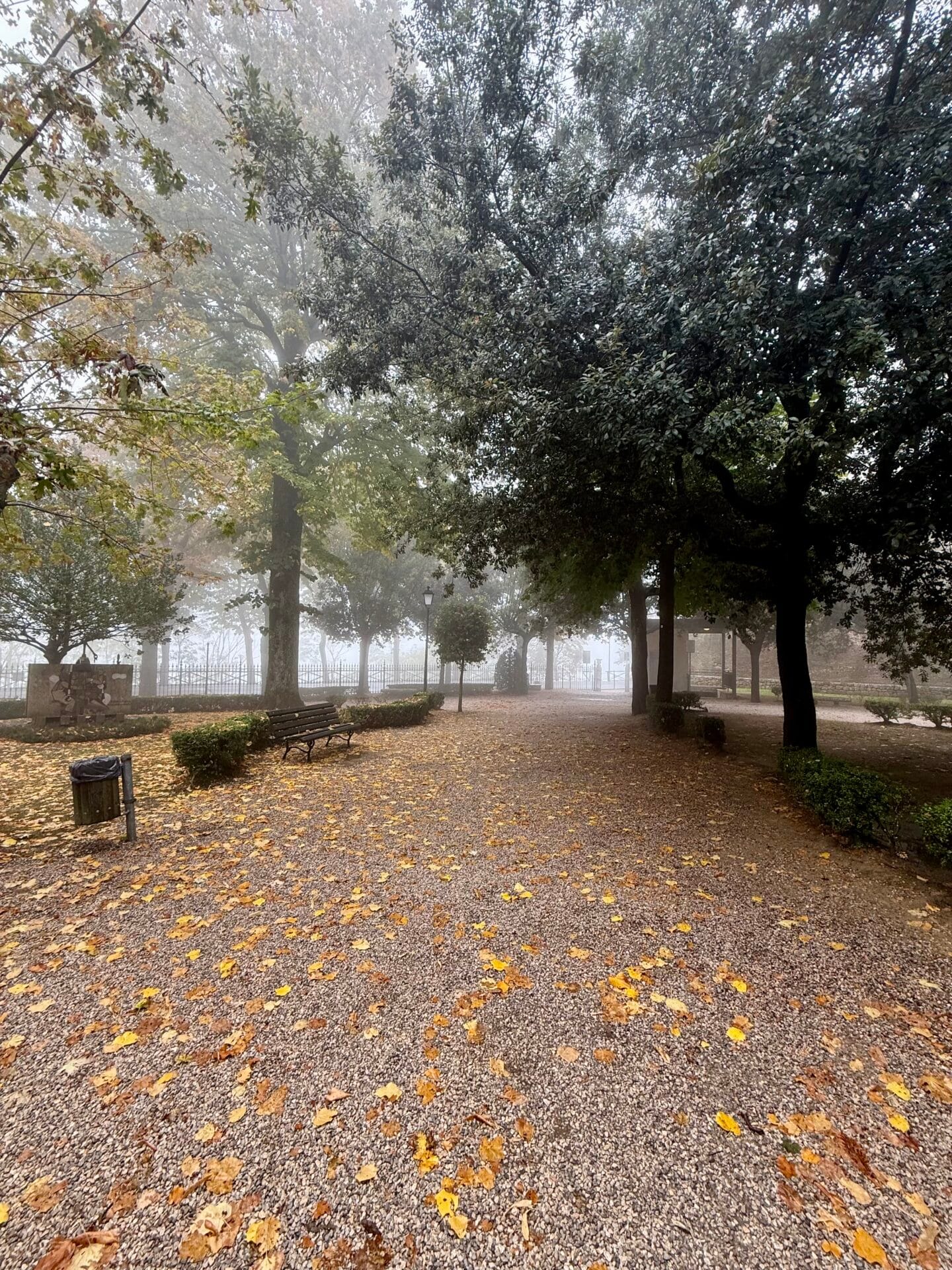
The gardens are neatly arranged with low box hedges, gravel paths, and old ilex oaks that provide plenty of shade. A stone figure stands in the center, and benches line the edges. There is a calm here that the outside world cannot reach.
Our Il Sasso group relaxed in the Horti Leonini, enjoying a well-earned moment of quiet. We sat under the oaks and practiced describing what we saw in Italian—the light, the shadows, the shape of the hedges—and let the afternoon slow down. I remembered my first visit to Italy as a KSU study abroad student, when everything was new. There is something special about coming back to a place as someone who wants to belong, not just visit. The Horti Leonini, with its 440 years of history, felt like the perfect place for that feeling.
What Else to See in San Quirico d'Orcia
The Collegiata di San Quirico, a Romanesque collegiate church from the 12th century, is at the heart of the town's impressive collection of sacred buildings. Its three carved portals are stunning up close, each with a different style and from a different century, coming together in a way that makes you pause. Inside, the church is quiet and simple, with a triptych by Sano di Pietro that is worth taking time to admire.
The Church of Santa Maria Assunta adds another dimension to a town that carries its spiritual history in a gentle but meaningful way.
And then there are the cypress trees. Outside the town walls, along the roads of the Val d'Orcia, the old cypresses of San Quirico stand out in the landscape, making them some of the most photographed trees in the world. They line the roads and dot the hillsides. In the early morning or at sunset, they become almost impossible to describe—the kind of view that shows why people have tried to capture this valley in art for centuries.
Keep your camera close. You won't regret it.
Practical Tips for Your Visit
- Getting there: From Montepulciano, take the SP146 toward Pienza and continue to San Quirico. About 30–35 minutes.
- Parking: Free parking just outside the town walls.
- When to go: Spring and early autumn for ideal light and fewer visitors. Early morning is best for the cypress roads.
- How long to spend: Two to three hours for a relaxed visit; half a day if you're combining with Bagni Vignoni.
- Don't miss: The Madonna's story inside the Chiesa di Santa Maria di Vitaleta, a quiet hour in the Horti Leonini, and at least one photograph of the cypress-lined road before you leave.
Why San Quirico d'Orcia Stays With You
Il Sasso has a special quality I did not expect when I started studying there: it helps you become a better traveler in Tuscany. It doesn't just give you a list of sights but gives you the tools—the language, the background, and the community—to experience places more deeply.
KSU started me on my journey to Italy. Il Sasso keeps helping me discover more. Days like this—a Madonna with centuries of stories, Renaissance gardens still growing quietly, and cypress trees that truly belong among the world's most beautiful—remind me why I chose to follow this path.